
What You Do in the Next 48 Hours Will Matter More Than You Think
Picture this: It’s 11 PM. You’re in the back of a police car, hands cuffed, mind racing. You’re trying to remember what you’ve seen in movies, what your rights are, what you’re supposed to say. Everything feels like it’s moving too fast and too slow at the same time.
That moment, that terrifying, disorienting moment, is exactly when the most damaging mistakes get made.
Being arrested in Atlanta does not make you a criminal. It does not mean you will be convicted. But it does mean you are now inside a system, Fulton County, DeKalb, Gwinnett, that is built to move efficiently, not necessarily in your favor. The decisions you make in the first 24 to 48 hours carry enormous weight.
This is not a scare tactic. This is what criminal defense attorneys see every single day.
Here are the mistakes that quietly destroy cases, and what you should do instead.
Mistake #1: Talking to the Police Without a Lawyer Present
This is the mistake that unravels more cases than any other. Not because people are dishonest, but because they genuinely believe that explaining themselves will help. It almost never does.
The moment you are in custody, every instinct tells you to talk. To clarify. To make the officer understand your side of the story. But here is what most people don’t know until it’s too late: police officers are legally permitted to lie to you during questioning. They can tell you a witness already named you, that your co-defendant is cooperating, that things will go easier if you just explain what happened. None of that has to be true. And every word you say in response, every offhand comment, every nervous clarification becomes part of the official record.
Under the Fifth Amendment, you have the absolute right to remain silent. Georgia fully upholds this right. But silence alone is not enough. The U.S. Supreme Court ruled in Berghuis v. Thompkins (2010) that you must explicitly invoke your right, out loud.
Say this, and say it only once: “I am invoking my right to remain silent. I want to speak with an attorney.”
Then stop. Don’t elaborate. Don’t apologize. Don’t try to seem cooperative. The time and place for your story is in front of a judge, with your attorney beside you, not in a fluorescent-lit room at 2 AM with someone whose job is to build a case against you.
Mistake #2: Waiting Too Long to Hire an Attorney
Most people tell themselves they’ll deal with it tomorrow. They’re exhausted, overwhelmed, and convinced there’s more time than there actually is.
In Atlanta, the criminal process moves fast. Charges can be formally filed within days of an arrest. Surveillance footage gets overwritten on 24 to 72-hour cycles. Witnesses’ accounts start shifting. Physical evidence gets catalogued, labeled, and locked behind prosecution walls. Every hour that passes without legal representation is an hour the other side is building their case while yours sits completely idle.
An experienced Atlanta criminal defense attorney, brought in early, can make moves that simply aren’t available later:
- Challenge whether there was probable cause for your arrest in the first place
- Identify procedural violations in how evidence was collected
- Intervene with prosecutors before charges are formally set
- Preserve surveillance footage, witness statements, and physical evidence that supports your defense
- File time-sensitive pretrial motions that can change the entire trajectory of the case
The first 48 hours are not just important, they may be the most important hours in your entire case.
Most Atlanta criminal defense attorneys offer free consultations and are available around the clock. The cost of that call is zero. The cost of waiting can follow you for years.
Mistake #3: Posting About the Arrest on Social Media
Put the phone down. This is genuinely not the moment.
It feels completely natural, when something overwhelming happens, we reach for our phones. We want to vent, to update the people who care about us, to feel less alone in what’s happening. But from the moment of your arrest until the final resolution of your case, social media is one of the most dangerous places you can exist.
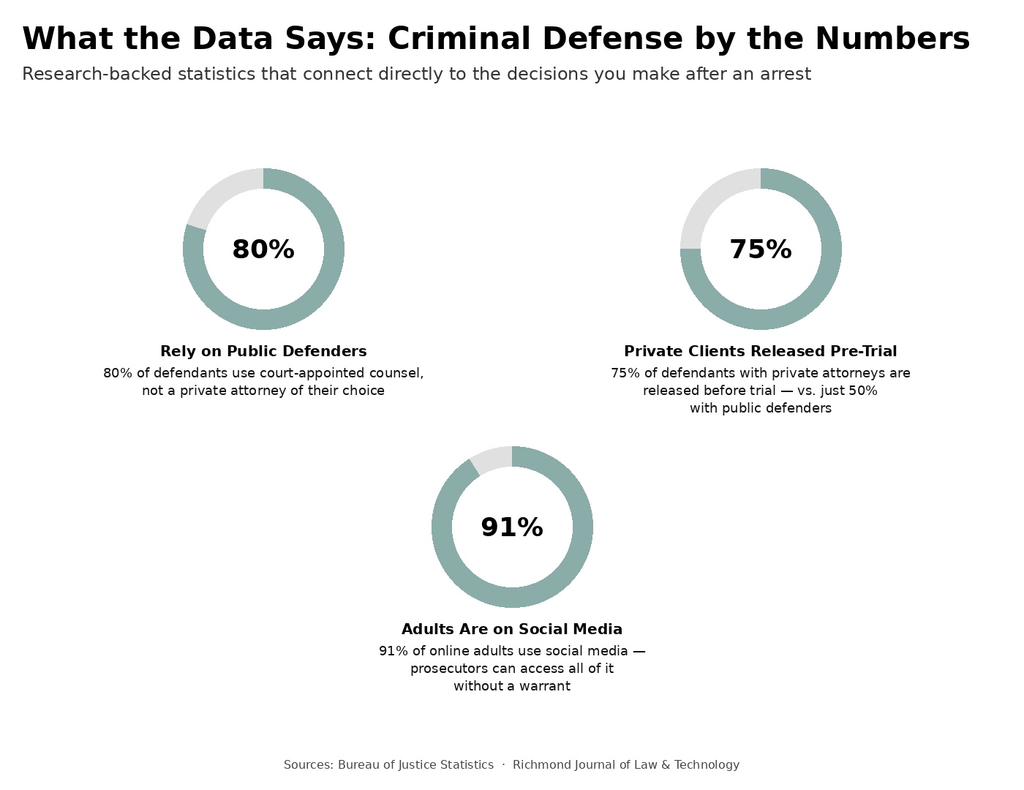
Prosecutors in Georgia routinely comb social media accounts as part of criminal investigations. Posts, photos, comments, check-ins, stories, all of it can be subpoenaed and introduced as evidence in court. There is no privacy setting strong enough to fully protect you. A photo from earlier that night, a vague “going through it” caption, a comment from a friend, any of it can be used to establish character, timeline, or intent in ways you never anticipated.
The rule is this: go completely dark across every platform until your case is fully behind you. Ask the people closest to you to do the same on your behalf. What feels like processing in the moment can become permanent, irreversible damage to your defense.
Mistake #4: Contacting the Alleged Victim
No matter how strong the urge, don’t reach out. Not once.
Whether you want to apologize, explain your side, or simply make sure the other person is okay, contacting the alleged victim after an arrest is a legal risk that people consistently and catastrophically underestimate. Under Georgia law, O.C.G.A. § 16-10-93 and § 16-10-97, contacting a victim or witness in a criminal case can be charged as witness tampering or intimidation, regardless of your intent or the tone of the message.
If the court has issued a no-contact order, which is standard procedure in domestic violence, assault, and harassment cases across Atlanta, violating it is a standalone criminal offense. It can trigger immediate re-arrest and signal to the judge that you cannot be trusted to follow court orders. That impression does not leave the room.
Even a text message that says nothing more than “I’m so sorry” can be read as an admission of guilt in a courtroom.
Every single piece of communication involving the alleged victim goes through your attorney. Your lawyer can handle what needs to be handled, retrieving belongings, co-parenting logistics, shared workplace situations, in a way that is legally protected. Trying to manage it yourself is not worth the risk.
Mistake #5: Ignoring Your Bail Conditions
The moment bail is posted, the relief is real. Don’t let that relief make you careless.
Bail in Atlanta is not freedom, it is conditional release granted by a judge, and the conditions attached to it are not suggestions. Violating them, even accidentally, can result in your bail being revoked and you being taken back into custody the same day. Worse, a bail violation sends a message to the court that will follow your case all the way to sentencing: that you don’t take their orders seriously.
Bail conditions in Fulton County and across the Atlanta metro commonly include:
- No contact with the alleged victim or any witnesses in the case
- Travel restrictions, you may not be permitted to leave the state of Georgia
- Regular check-ins with a pretrial supervision officer
- Mandatory drug and alcohol testing
- Electronic monitoring or curfew requirements
Read every condition. Understand every condition. If something isn’t clear, call your attorney before assuming it doesn’t apply to you. If a condition creates a genuine, documented hardship, a no-contact order that affects a shared workplace, for example, there is a legal process to request a modification. Use it. Ignoring the problem and hoping it goes unnoticed is never a strategy.
Mistake #6: Accepting a Plea Deal Without Legal Advice
Prosecutors understand one thing very well: stress makes people settle. Early plea offers are frequently designed to catch defendants before they have proper legal counsel, and before they fully understand what they’re giving up.
When you’re exhausted and just want the whole thing to disappear, a plea deal looks like the fastest exit. Often, it is a door that locks permanently behind you. Pleading guilty even to a lesser charge, creates a permanent criminal record in the state of Georgia. That record can affect job applications, professional licenses, housing eligibility, child custody arrangements, and depending on your status, immigration outcomes.
And that’s before you consider what you’re waiving: your right to trial, your right to contest the evidence, and in many cases your right to appeal. The deal prosecutors offer on day one is almost never their strongest position. It is the opening move of a negotiation, and accepting it without an attorney means you walked into that negotiation alone and already lost.
A skilled criminal defense attorney may be able to get charges reduced, secure a diversion program that ends in full dismissal, or find enough weakness in the prosecution’s case to make trial the smarter path. None of those options stay on the table forever. But none of them disappear as quickly as your rights do the moment you sign a plea agreement without legal counsel.
Mistake #7: Assuming a Public Defender Has Enough Time for Your Case

This is not a criticism of public defenders. It is an honest look at the system they are working inside.
In Fulton County and across metro Atlanta, public defenders routinely carry caseloads of 80 to 150 active cases at a time. That is not a sustainable number for the depth of attention a serious criminal charge requires. Through no fault of their own, your public defender may have limited time to investigate your case independently, consult outside experts, pursue every strategic filing, or sit down with you for the kind of extended conversation your situation actually warrants.
If the stakes are high, a felony charge, a mandatory minimum sentence, anything touching your professional license, your parental rights, or your immigration standing, you owe it to yourself to at least speak with a private criminal defense attorney before deciding your default option is your only option.
Many Atlanta criminal defense attorneys offer flexible payment plans. The financial investment in experienced representation is almost always smaller than the long-term weight of a conviction that might have been avoided.
Mistake #8: Destroying or Tampering With Evidence
Fear drives people to do things they would never otherwise consider. This is one of those decisions you absolutely cannot take back.
Deleting text messages. Throwing away items connected to the incident. Asking a friend to quietly “take care of something.” Every one of these actions feels, in the moment, like damage control. Under Georgia law, O.C.G.A. § 16-10-94, it is a felony. Evidence tampering is a charge that lands directly on top of whatever you were already facing, and it is one of the most damaging signals you can send to a judge or jury.
Here is the reality: if investigators are looking for something, they often already know it exists. Digital deletion leaves metadata. Surveillance catches more than people expect. And when a jury hears that you tried to destroy evidence, it communicates one thing louder than any argument your attorney can make, that you knew you were guilty and acted on it.
Leave everything untouched. Let your attorney determine what is relevant, what is protected, and what can be legally challenged. Evidence your lawyer can contest in court is a tool. Evidence you’ve destroyed is a crime. And a new crime on top of an existing charge is a situation no one wants to be defending.
What You Should Do Right Now

An arrest is not a verdict. People beat serious charges in Atlanta every single day, not by luck, but because they stayed calm, protected their rights, and made smart decisions from the very first moment.
The window for those smart decisions is open right now. It won’t stay open forever.
If you or someone you care about has been arrested in Atlanta, do not try to navigate this alone. The courts know the system. The prosecutors know the system. You deserve someone in your corner who knows it just as well, and who is fighting specifically for you.
Frequently Asked Questions
What should I do first after being arrested in Atlanta? Invoke your right to remain silent and request an attorney immediately. Do not answer questions, attempt to explain the situation, or try to negotiate with officers on the scene. Contact a criminal defense attorney as soon as you are able, within the first 24 hours is ideal.
Can I talk my way out of an arrest? In almost every case, no. Once an officer has decided to make an arrest, talking rarely changes that outcome, but it almost always produces statements that can be used against you later. Your right to remain silent exists precisely for this situation. Use it.
How soon should I call a lawyer after being arrested in Georgia? As soon as possible. Early legal involvement gives your attorney the widest range of options — including challenging probable cause, preserving evidence, and engaging prosecutors before the case against you is fully constructed. Every hour matters.
Disclaimer: This article is intended for general information about Georgia criminal law and is not legal advice. Criminal cases vary significantly based on individual facts and circumstances. If you have been arrested in Georgia, please consult with a qualified attorney about your specific situation.
Still Have Questions? Ready To Get Started?
For more information on any criminal charges in Atlanta, a free initial consultation is your next best step. Get the information and legal answers you are seeking by calling (404) 600 – 0190 today